
Here come the Piggies backed by the CCP, Gen Z loves socialism, SpaceX down 33% off it's high— we told you so, the era of easy AI capital is done, and more crazy-ish sh*t...

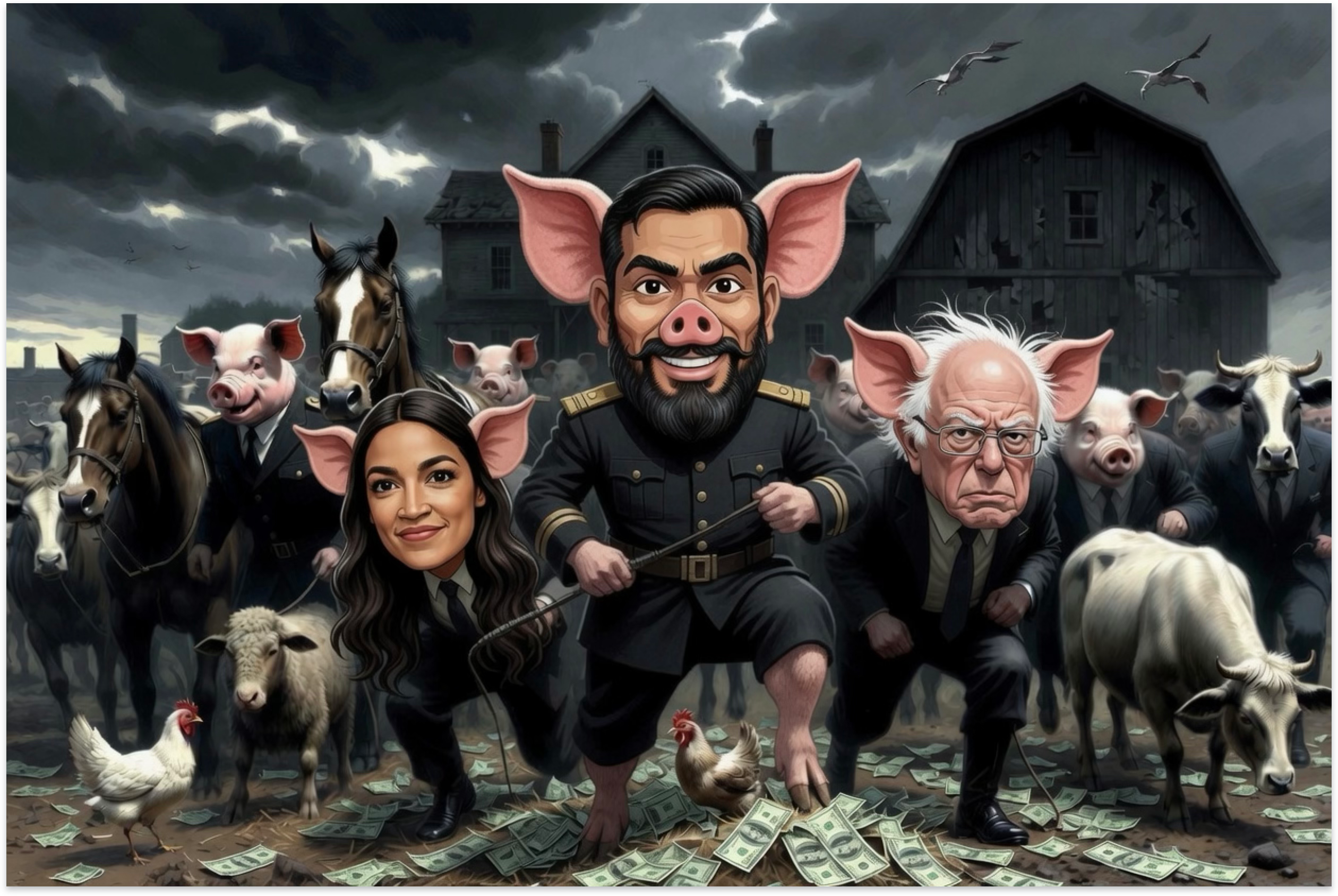
Here we come
Walkin’ down the street
We get the funniest looks from
Everyone we meet
Hey, hey, we’re the Piggies
People say we piggy ‘round
But we’re too busy spending
While we take the Israelis down
We regulate whatever we want to
Tax and punish the rich
We don’t have time for The People
But we always have time to bitch
Hey, hey, we’re the Piggies
We don’t mess around
We’re the new generation
And we’re gonna take this country down
With apologies to The Monkees — and a nod to Orwell’s pigs, who declared, “All animals are equal, but some [the Pigs ruling the farm] are more equal than others.”
Why the New American Socialism is an anti-trend
While there is a growing concern in many quarters of the United States regarding the rise of the Democratic Socialists of America (DSA), we are not concerned. Yes, New York City — the capitalist capital of the world — elected a socialist mayor, and three DSA congressional candidates recently won Democratic primaries for Congress, with another favored to win the mayorship in Washington, D.C., a city allergic to Republicans. But they represent a major anti-trend that has no legs.
The Democratic Socialist agenda
Anti-Israel foreign policy and skepticism of traditional U.S. alliances
Defund the police and criminal justice “reform” featuring reduced prosecutions and lighter sentencing
Heavy wealth redistribution through confiscatory taxation on high earners and corporations
Government-controlled universal healthcare and a vastly expanded welfare state
Radical housing policies, including strict rent control, massive public housing expansion, and “social housing”
Open borders and mass immigration, paired with amnesty and sanctuary city policies
Aggressive emphasis on identity politics and cultural redistribution
We will get to the real anti-trend issue in a moment, but allow us to briefly nitpick a couple of their top seven platform issues.
Defund the police? Where?
In terms of defunding the police, one wonders whether the DSA respects that in higher-crime and mixed neighborhoods, 92% of residents want more or the same police presence (52% more, 40% the same) — and only 8% want less. So what people are they trying to support and protect?

Teaming up with tyrants to spread antisemitism
We have been clear in our view on U.S. taxpayer support for Israel and concerns over some of its war tactics in Gaza, which we discuss more below. That said, do DSA activists and their allies realize that a troubling mix of foreign backers—Qatar, Iran, and others who actively oppress women, criminalize homosexuality, execute apostates and protestors in their own countries, and enforce authoritarian Islamist rule—are helping fund and organize the anti-Israel protests on U.S. campuses? The DSA’s ideological hypocrisy here cannot be denied.
It is hardly surprising that these protests, fueled by such tyrants, have helped mainstream antisemitic rhetoric and driven a nationwide surge in antisemitic incidents—rising dramatically, with reports of increases exceeding 400% since October 7, 2023.
Jewish students have faced random harassment, glorification of the October 7 massacre, and a dangerous blurring of lines between legitimate policy criticism and outright Jew-hatred. The fear has spilled far beyond campuses.

Qatar’s real story
Absolute monarchy. No free speech or assembly. Male guardians control women’s rights to marry, travel, work, and healthcare. Migrants (90%+ of the population) endure kafala exploitation, and homosexual relations are criminalized. Yet it funds US campus activism against Israel and the West in general.
To be fair, very few student activists—likely in the single digits—are aware of the extremist connections behind the movement. Still, DSA leaders must know this connection and, by definition, are supporting the gross manipulation of idealistic youth to advance their goals. FACTS.
Americans do not trust centralized government control
The DSA’s push for classic socialism — shifting economic power, decision-making, and resources away from private individuals, free markets, and voluntary exchange toward the state and connected elites — runs directly counter to the long-term American trend of eroding trust in centralized authority.
Since the 1960s and 1970s, Gallup has documented a sustained decline in Americans’ trust in the federal government. The percentage who say they trust government to do what is right “just about always” or “most of the time” has fallen from highs above 70% to the mid-teens in recent years.
The AI and blockchain era will deliver what Americans really want
Since the personal computer revolution (late 1970s onward), innovation emanating from Global Silicon Valley has been the single most transformative force shaping culture, daily life, work, communication, entertainment, and even politics — more than any other societal driver.
Cryptonite readers are privileged because we are among the first to see and take advantage of these new innovations. But we also know that while we may love our new bag of tricks, only those that make people’s lives more efficient and less expensive will endure.
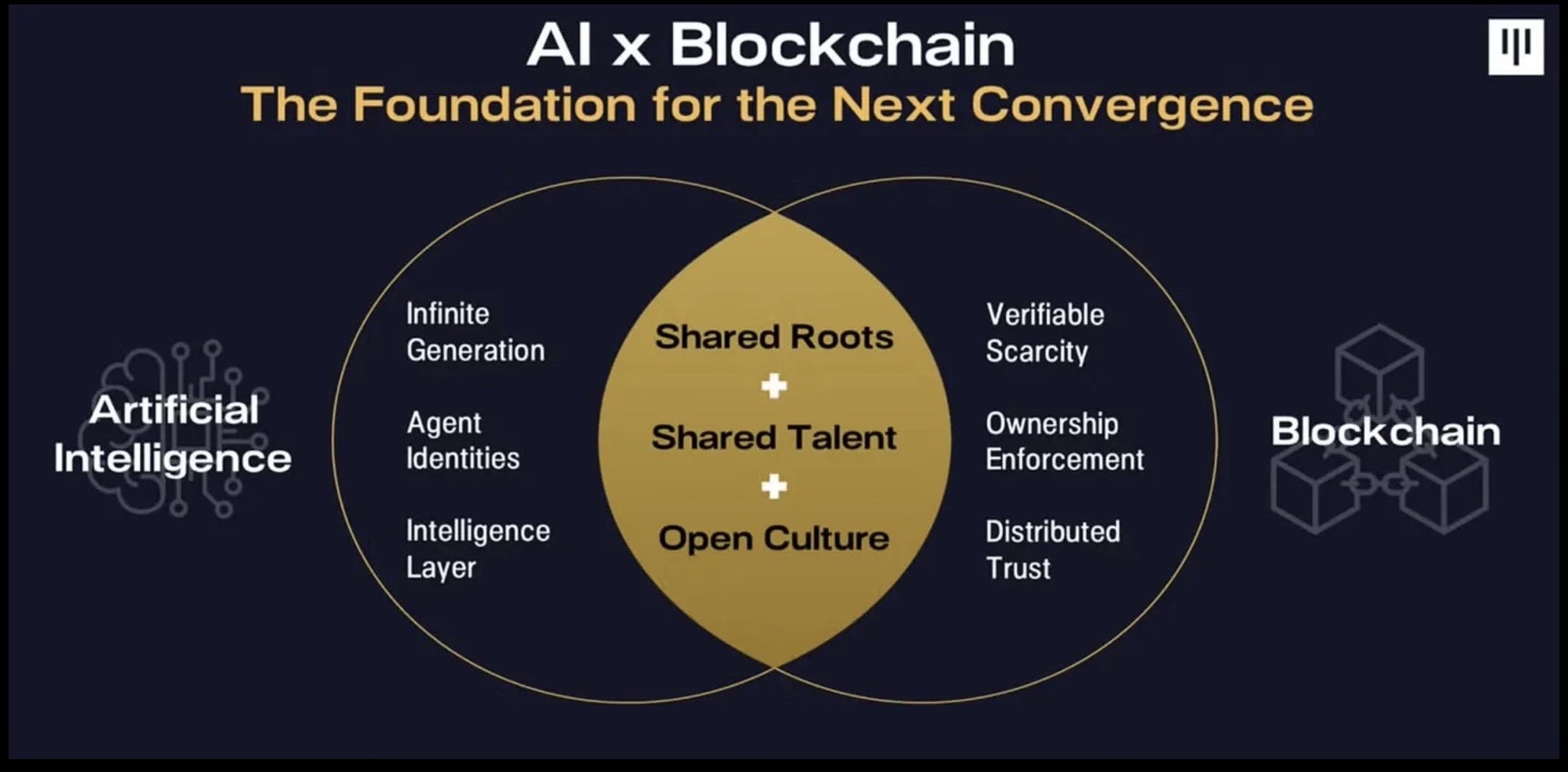
The Web3 era is centered on the fusion of AI, blockchain, and decentralized apps. It is already clear that we will enjoy exponentially greater efficiency at fractions of historical cost. Most importantly, we are busy building AI-powered permissionless networks that meet Americans’ desire to reclaim power, privacy, and economic sovereignty — exactly as the Gallup polls suggest.
We could go on and on about our favorite subject, but we already know you know this is true. The future belongs to systems that empower people and free them from centralized control. Is there any room for wanna-be Bolsheviks in this cultural shift? We don’t think so — and that is why we are not worried that the Piggies will prevail.
Why Gen Z loves socialism
The core demographic powering DSA-endorsed candidates is remarkably narrow, predictable, and ironic—and some say fueled by “white guilt.” It is overwhelmingly White (~85%), highly educated (80%+ with college degrees), and composed of white-collar professionals — many in academia, tech, and nonprofits— with most earning north of $100k and clustered in urban/coastal “progressive” enclaves.
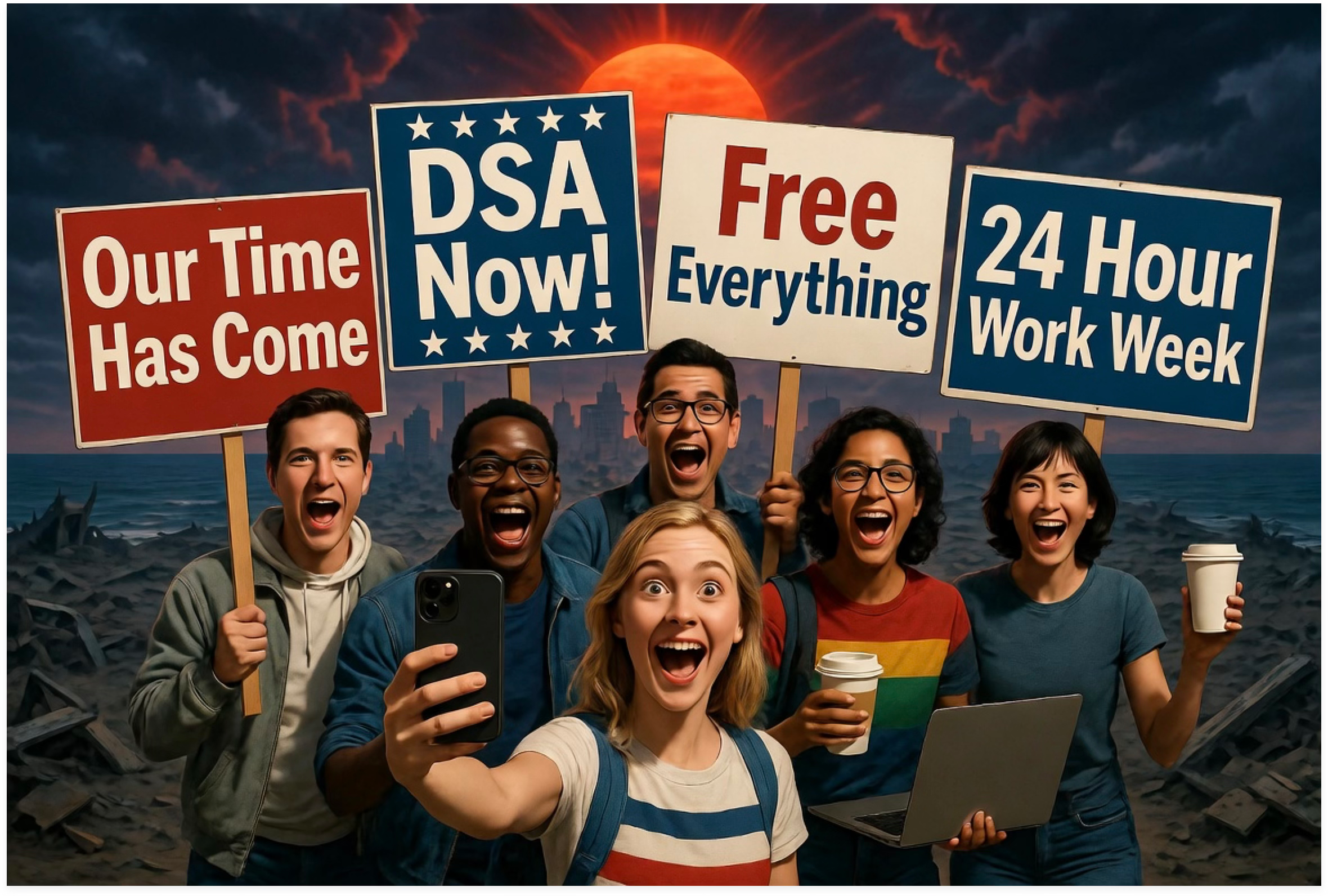
Not surprisingly, Gen Z (born ~1997–2012) has had an outsized role in DSA successes. In Zohran Mamdani’s 2025 NYC mayoral win, young voters showed strong turnout, with ~75% voting for their DSA leader. Harvard Youth Polls and others show Gen Z far more favorable to “democratic socialism” than older generations — often 40- 50%+ positive in left-leaning subsets.
Gen Z hiring challenges 🤯
Recent surveys show 74% of managers consider Gen Z the most difficult generation to work with, citing lack of motivation, poor communication, weak adaptability, and unprofessionalism. One in six companies now hesitates to hire recent Gen Z graduates due to chronic lateness, entitlement, hypersensitivity to feedback, and inability to collaborate. Over 90% of hiring managers say recent Gen Z grads simply aren’t ready for the real workplace — and many are let go within the first few months.
Of course, Gen Z loves socialism—they were born into families, educational institutions, and a social media-driven world that fosters entitlement, coddling, and expecting everything for free without having to show up to a job and put in a solid day’s work.
The Cryptonite Take. The DSA movement is a mere flash in the pan that will dissipate once voters experience Mamdani-style governance in the real world. Punitive taxes will drive employers and talent out of the city, triggering surging disorder and fiscal chaos, and rising crime and antisemitism.
The Zoomer-led DSA activist will ultimately realize that free stuff always comes with long lines, declining quality, and the working class paying a disproportionately higher share of their income to foot the bill.
The end of the Democratic Party as we know it?
Billionaire Peter Thiel is far less optimistic about containing the socialist surge than many of us. Speaking to a stunned, largely liberal audience at the Aspen Institute’s Ideas Festival, Thiel, a classical liberal (in the French Revolutionary sense) warned bluntly that “I think there’s going to be a democratic socialist takeover in the Democratic Party.”
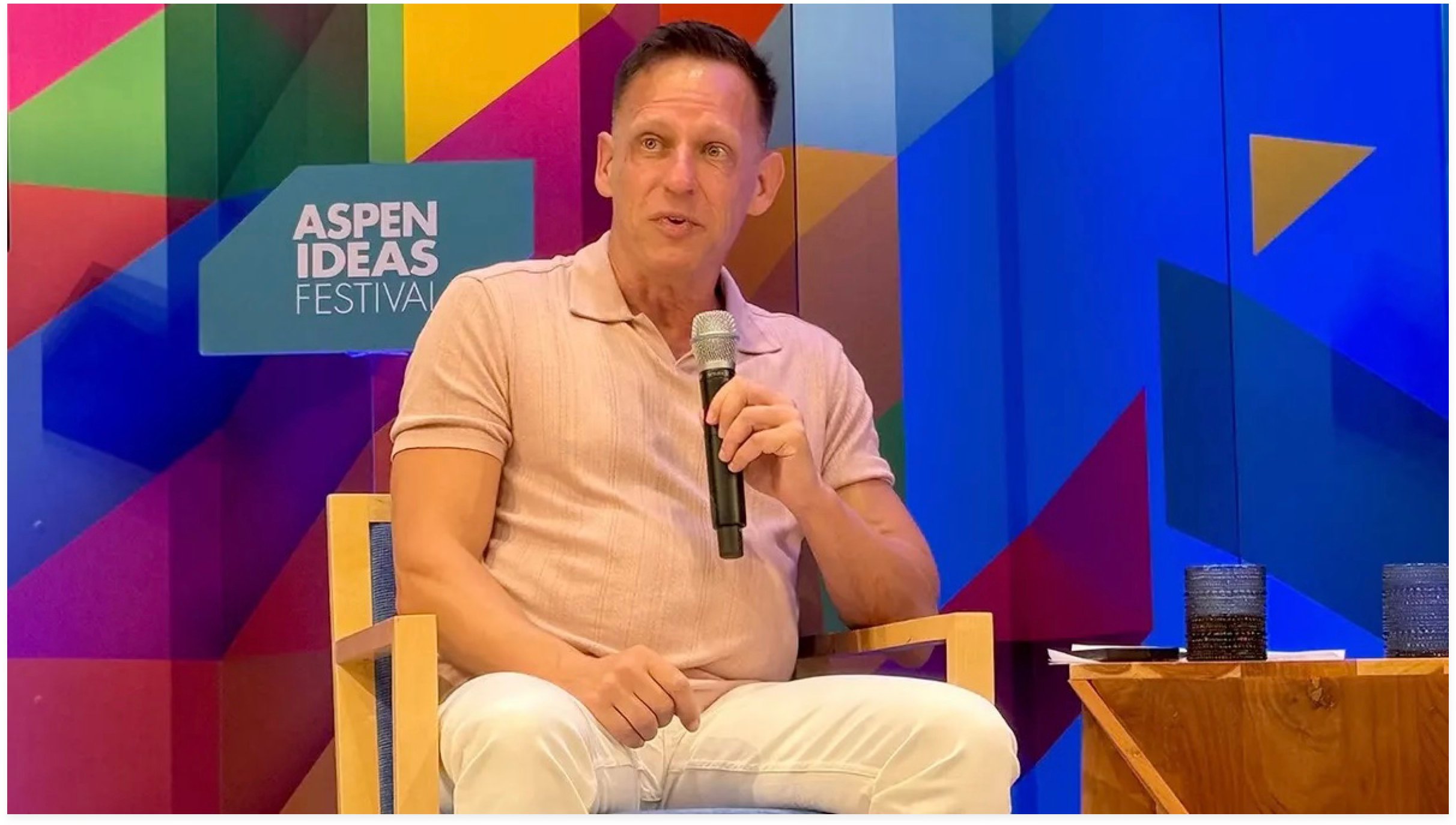
He ties this fear to something deeper and more dangerous than mere politics — a creeping cultural, technological, and economic stagnation that’s hitting younger generations hardest. “My generation was the first one where things felt really stuck,” Thiel said. “I think millennials are doing less well than their Boomer parents. It’s even more deeply felt in Gen Z.”
If the Democrats fully surrender to the democratic socialists — the Mamdani wing and its DSA allies — Thiel’s verdict is stark. “If the Democratic Party goes socialist, this country is over.”
The deeper problem, he argued, is that stagnation breeds resentment, and resentment demands villains and redistribution. That path, Thiel fears, leads to sabotaging the one force capable of breaking the deadlock — technological progress, especially AI.
“If we just have this economic stagnation, that’s the road toward total catastrophe,” Thiel warned. “I’m extremely alarmed about a tendency to slow it down or stop [AI] because I think the alternative is not the world ending with a whimper. It is zero-sum, Malthusian, deranged politics. People get angrier and angrier. It’s not going to work.”

The DSA’s alignment with the CCP playbook
The Democratic Party’s sharp leftward shift toward democratic socialism is also being supercharged by massive funding from ideological donors with ties to radical agendas — including networks aligned with Chinese Communist Party interests. Two major streams stand out — the Soros family ecosystem and, most notably, the Neville Roy Singham network.
The China-based American tech billionaire Singham (former ThoughtWorks founder) has funneled an estimated $278 million into U.S. organizations promoting Marxist organizing, socialist policies, identity politics, and anti-U.S. messaging. Funds flowed through nonprofits like People’s Forum, Tricontinental, and CodePink.
The DOJ has launched a federal grand jury investigation in the Southern District of New York into Singham’s funding activities, with subpoenas issued for bank records as part of a probe into potential financial crimes, including wire fraud, bank fraud, and money laundering.
These networks, including Singham-aligned groups, closely follow classic CCP talking points and influence operations (via the CCP organ United Front Work) that, surprise, surprise, mirror the DSA platform:
Promote multipolarity to weaken U.S. leadership and alliances, especially vs. Israel, mirroring DSA’s anti-Israel policy, aid cutoff calls, and “Free Palestine” framing.
Amplify internal divisions on race and economic inequality to sow domestic chaos, directly aligning with DSA’s aggressive identity and cultural politics.
Amplify immigration divisions, aligning with DSA’s open borders and sanctuary policies.
Criticize capitalism and Western institutions while promoting socialist and Marxist alternatives that align with DSA’s wealth redistribution goals.
Undermine U.S. partners and advance the CCP’s United Front Work — blending funding, propaganda, and narrative control to erode cohesion without direct confrontation (evident in campus protests and anti-Israel activism).
Singham-aligned groups routinely amplify Chinese state rhetoric while bankrolling radical activism. This is ideological subversion 101: exacerbate America’s fractures to diminish U.S. power. The DSA’s agenda maps almost perfectly onto this playbook. 🤔
The Cryptonite Take: We are less alarmed than Peter Thiel is about a full-fledged democratic-socialist takeover of the Democratic Party. This remains a loud but ultimately shallow anti-trend that clashes with Americans’ deep distrust of centralized power and our accelerating shift toward decentralized technologies like AI and blockchain.
That said, we must remain vigilant by confronting foreign regimes that despise America and the free world that are infiltrating our institutions and manipulating idealistic students. This is ideological subversion by design, exploiting Gen Z’s frustrations and entitlement to erode American cohesion from within.
The DSA may fade under real-world failure, but the foreign hands guiding it will stay unless we do something about it.

Update on the US negotiations with Iran 😳
The regime in Tehran is once again showing the world what radical Islamism in power looks like.
Last week, Iran’s 88-member Assembly of Experts — the body constitutionally tasked with selecting and supervising the Supreme Leader — issued a 10-point statement explicitly calling for the assassinations of President Donald Trump and Israeli Prime Minister Benjamin Netanyahu.
The clerics declared both leaders “mahdour al-dam” (blood worthy of being shed) and framed killing “the wicked prime minister of the Zionist regime” and “the criminal American president” as a religious duty “under any circumstances.” They went further. “It is obligatory upon any duty-bound person who gains access to these criminals to send them to hell.”
They dismissed the cease-fire talks as a U.S. delay tactic ahead of the 30- and 60-day deadlines in the 14-point memorandum of understanding, while urging supporters to flood the streets “in the leader’s name.” Iranian state outlet Hamshahri reinforced the mood with a Trump-in-crosshairs message — “Revenge is certain.”
President Trump responded hours after ordering new U.S. airstrikes on more than 80 Iranian targets in retaliation for Iran’s attacks on commercial ships in the Strait of Hormuz. Speaking to reporters at the NATO summit in Ankara, Turkey, he was blunt:
“It’s a very interesting question. To me, I think it’s over. I don’t want to deal with them anymore. They’re led by sick people — very vicious, violent people. And if they had a nuclear weapon, they’d use it. As far as I’m concerned, it’s [the ceasefire] over. ... They’re liars, and they’re cheats. ... Our negotiators can keep talking if they want; I believe they’re wasting their time. ... Iran wants to take out the U.S. leader — me. I am on every single one of their [assassination] lists. ... These are evil, sick people and we have to rid them of their cancer. They’ve been the bully of the Middle East, and they’re not the bully anymore.”
Later in the day, during his meeting with Ukrainian President Volodymyr Zelensky on the sidelines of the NATO summit in Ankara, Trump expanded on the U.S. response and warned of further action.
“We hit them very, very hard last night. I’ll probably hit them hard again tonight [He did]. I’ll give them a little warning: we’re going to hit them hard tonight, but we’ll see how it all works out. In one day, we could knock down every single bridge in Iran. There’s not a thing they can do about it. They have desalination plants. We’ll take them out if we have to. Maybe we’ll take over Kharg Island.”
Trump also confirmed the U.S. had “knocked out 28 boats last night” using the same weapons previously employed against drug smugglers, floated reimposing a naval blockade on the Strait of Hormuz, and claimed, “We’ve already got the nuclear material because it’s so far underground, nobody’s going to be able to get it except us.”
Latest developments: Iran retaliated with missile and drone strikes on U.S. positions in Kuwait, Bahrain, and Jordan. Trump declared the ceasefire “over,” reimposed oil sanctions, and authorized additional targeted strikes on Iranian military assets. High-level negotiations are paused amid the escalation, with technical talks possibly continuing; oil prices spiked as both sides signal readiness for further action while leaving a narrow path for de-escalation.
The Cryptonite Take: Regime surrender remains the only option, which Trump has always understood. He finally revealed this card openly after once again learning the regime’s explicit desire to take him out. The clerics got one thing right — the ongoing cease-fire negotiations have been a Trump “delay tactic” while our sanctions, freezing of assets, the regime’s crumbling economy, and the will of the vast majority of the Iranian people to be free force surrender.
Our prayers continue to be that this transition to a free Iran happens without any loss of American or innocent Iranian lives. We still bet it will.

In an age when much of what Americans hear about Islam arrives only through the narrow lens of headlines — terrorist attacks, suicide bombs, hostage crises, or the declarations of oppressive regimes — clear thinking has become both rare and essential.
The overwhelming majority of Muslims worldwide, including the many successful professionals and entrepreneurs in Silicon Valley, are peaceful men and women who treat their religion as a personal matter of devotion, ethics, family, and community. Radical Islamists represent only a minority (roughly ~10% or less), yet free countries have every right — and duty — to rigorously filter immigrants for ties to jihadist or terrorist organizations.
To set the Cryptonite record straight on these issues, we drafted the editorial positioning statement above on the subject.
Seizing the narrative on Israel and Iran
Foreign influence on campuses, Trump-obsessed corporate media, and conspiracy theories have poisoned the discourse on our alliances with Israel and actions in Iran. This has fueled DSA radicalism and antisemitic spikes.
At Cryptonite, we stand firmly with Israel’s right to exist and thrive as a sovereign democracy, while celebrating the immense contributions of Jewish Americans. We also back decisive U.S. efforts to dismantle the Iranian theocracy—for the safety of Americans and the liberation of the Iranian people—provided we avoid endless ground wars and American casualties.
It’s time to reclaim the narrative with moral clarity.

A Neocon echo from unjust wars past
Israel’s response in Gaza went beyond necessity. Palestinian deaths now exceed 73,000 (per Gaza Health Ministry), against roughly 2,000 Israeli deaths since October 7. Hamas bears demonic responsibility: using civilians as shields, embedding in hospitals and schools, and provoking devastation it welcomed. Protesting students, take note.
Yet Israel, knowing Hamas’s playbook, overplayed its hand in scale—avenging 1,200 murdered, the injured, and hostages with destruction that raises serious questions of proportionality under St. Augustine’s just war criteria. Hamas’s attack failed every test; Israel had right on its side, but excess civilian suffering demands honest critique.
Contrast this with smarter U.S. leadership. The Trump administration’s targeted operation captured Nicolás Maduro, freeing Venezuelans from tyranny—with just 7 U.S. soldiers injured and no major civilian deaths reported. In Iran, precision strikes have gutted the regime’s army, air force, navy, nuclear program, missiles, and proxies—toppling the theocrats with minimal U.S. losses and limited civilian toll, no boots on the ground.
Israel must not emulate the neocons of failed, open-ended wars. We say this as friends.
Time for Israel to stand on its own feet
In an era when we are rightly revisiting our massive taxpayer-funded foreign charity (a.k.a. aid) program, it’s time to cut the umbilical cord and end the ~$3.8 billion per year we give Israel.
This is not punishment or abandonment—it is respect for Israel’s economic strength. Netanyahu has publicly signaled openness to eventual reductions in U.S. aid, noting that “Israel is strong enough to stand more on its own” thanks to high-tech exports, natural gas, and defense industry self-sufficiency. He has framed it as a long-term goal for Israeli independence. We say this should be an immediate goal. Let’s do it now!
President Trump also delivered historic breakthroughs for Israel through the Abraham Accords, normalizing relations with the UAE, Bahrain, Morocco, and Sudan — opening new economic, technological, and security partnerships that have already boosted trade, innovation, and regional stability.
With a successful regime change in Iran, the Middle East and Israel will thrive even more dramatically. The removal of the leading state sponsor of terrorism would allow normalized relations to expand across the Sunni Arab world, unlock massive energy and infrastructure projects, reduce proxy wars and missile threats, and let Israel focus on its extraordinary economic and technological potential as a beacon of prosperity rather than perpetual conflict.

“Champs, baby! What they gonna say now?”
— Steph Curry after he and the Warriors won their fourth NBA Finals in 2022, after the sports talking heads said it couldn’t happen.
If we call out Israel on the Gaza atrocities and contrast them to our new life-saving tactics in Venezuela and Iran, cut Israel’s U.S. taxpayer charity, while continuing to broker deals throughout the Middle East — we can drop the mic on the DSA and our global detractors who have demonized us. 💪🏽😎
Flashback interview with a Nobel Peace Prize winner

SpaceX down 33% off its high — Still heading south
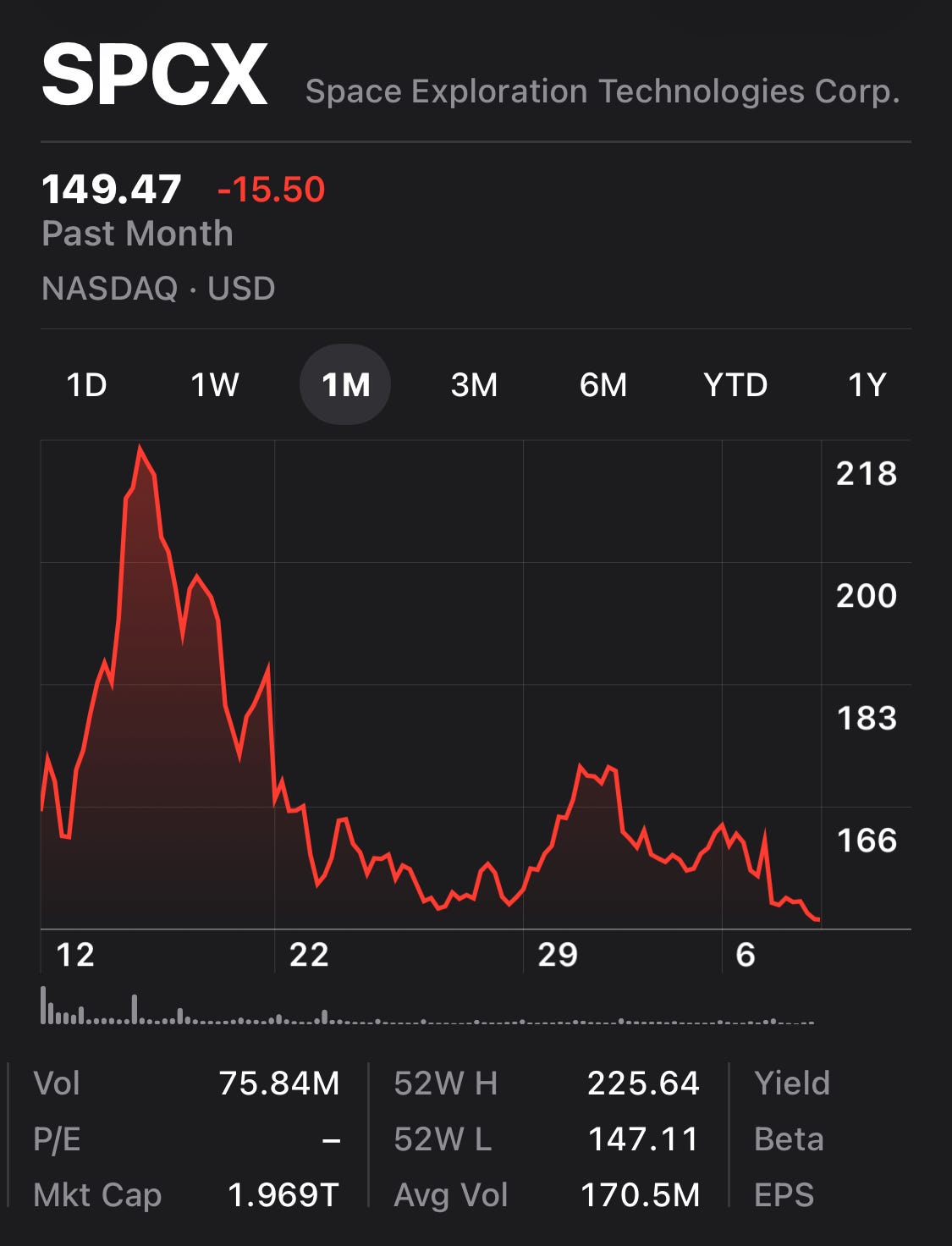
As we predicted in our last Rap, SpaceX shares have fallen 33% since its post-IPO high. Watch for the stock to get into the $70 range before you consider jumping in — but that may still be too high (Morningstar says $62–$63) for it to reach its proper P/E.

The Magnificent Seven Pullback
The Magnificent Seven sold off sharply in June as investors re-priced the AI trade, shedding roughly $2.3 trillion in market value and entering correction territory. So far in July, they are holding steady.
We do not view this pullback as a rejection of AI. It’s a healthy — and overdue — shift from narrative premium to demands for durable profits, capital efficiency, and real execution. The market is now asking tougher questions: How quickly will massive capex convert into free cash flow? Which leaders are built for the next phase, and which were riding hype?
For Silicon Valley founders, operators, and investors, the message is clear. Winners will convert scale into sustainable cash flow — not just headlines. Concentration risk has been exposed. Discipline, unit economics, and execution are back in the driver’s seat.
The Cryptonite Take: The era of easy AI capital is ending.
P.S. Oh, and Anthropic, OpenAI, and SpaceX are now bigger than the last 25 years of tech exits combined. A striking milestone showing extreme concentration of value creation in frontier AI. This intensifies winner-take-most dynamics and makes talent, compute, and distribution even scarcer. 😳

Trump-as-VC looking good for taxpayers
While we continue to loathe the Trump family’s blatant self-dealing, their growth funding expertise is at least delivering results for American taxpayers.
In a notable evolution of U.S. industrial policy, the Trump administration has shifted from traditional grants and tax incentives to direct equity stakes in strategically important companies, funded with taxpayer dollars. As a dealmaker by trade, President Trump is securing ownership for taxpayers to capture upside and exert strategic influence rather than simply handing out one-way subsidies.
Major confirmed U.S. equity deals (as of early July 2026)
Intel — $8.9 billion for ~10% equity stake (largest deal, passive investor with no board seat). The returns on this deal will be HUGE.
MP Materials (rare earths) — Significant stake (~15%), making the Department of Defense the largest shareholder.
Quantum Computing Package — $2 billion across 9 companies, including ~$1 billion to IBM and $375 million to GlobalFoundries. Visionary.
Rare Earth / Critical Minerals — Equity stakes (5–15%) in at least 5 companies.
SandboxAQ — $500 million for a minority stake. Smart.
Other moves — Lithium Americas, nuclear energy projects, and a “golden share” in the U.S. Steel deal.
Broader reporting puts the total at roughly 10–30 equity-related deals committing tens of billions, focused on semiconductors, quantum, critical minerals, and competing with China. Historically, we’ve been no fan of government playing VC and gambling with taxpayer dollars in this sophisticated insider game. But we have to admit that Trump’s wheeler-dealer instincts and his Tech Bro advisors have produced an impressive portfolio of deep, frontier tech investments.
This marks a sharp departure from past failures such as the Obama-era Solyndra bankruptcy ($535 million in taxpayer losses) and other DOE flops. Even in the case of Tesla — where the DOE provided a $465 million loan in 2010 that arguably saved the company from extinction — the government only made a modest profit of roughly $20 million, according to Elon Musk at the time.😳 A seasoned VC would have structured it very differently — not as a plain loan, but as debt + equity, and that stake would be worth tens of billions today at Tesla’s peak market cap. 😎🤙🏼

Did you know?💡
Stay relevant and on top
Below is the breaking news and inside wisdom you need to stay relevant and on top of emerging private tech companies, VC investors, Big Tech, and the innovation trends shaping the global Silicon Valley. All links lead to AI-generated research from a decisively venture-capital perspective.
Are we missing any action? Hit us up now on X @CryptoniteRap or TheEditor@CryptoniteVentures.com
Buzz Worthy
🗣️ Marc Andreessen and Blake Masters appointed to Defense Department Policy Board — bringing prominent Silicon Valley voices into high-level Pentagon advisory roles. Andreessen (a16z co-founder) has long championed “American Dynamism,” investing heavily in defense tech, aerospace, and national-security startups.
Masters (Thiel protégé, co-author of Zero to One) focuses on tech competitiveness and countering China. Both vocal Trump supporters. The picks signal the administration’s desire to embed pro-innovation, hawkish-on-China tech leaders to accelerate commercial tech adoption (AI, autonomy, semiconductors) for military advantage. | (June 29, 2026)
🗣️ SpaceXAI releases Grok 4.5, which Elon describes as an ‘Opus-class model’; joint development with Cursor and internal SpaceX AI advances using the tool. Elon’s ecosystem continues delivering practical, cost-efficient models amid the inference wars. Vertical integration and real-world data moats prove more valuable than pure lab research — pressuring pure-play labs and favoring hybrid, mission-driven teams. | (July 8, 2026)
🗣️ OpenAI set to publicly launch GPT-5.6 family; researcher claims it outperforms most human interns at AI research tasks. BofA extends $520M loan. Frontier labs keep iterating rapidly despite constraints. Recursive self-improvement signals are here — expect higher bars for everyone else and more focus on reliable deployment over raw benchmarks. | (July 7, 2026)
🗣️ OpenAI unveils custom Jalapeo inference chip with Broadcom. Another step in vertical integration by frontier players — should lower long-term inference costs but raises the bar for startups lacking similar resources. Specialization, efficiency, or alternative compute layers become critical. | (June 2026)
🗣️ Khosla-backed PrismML claims breakthrough with largest-ever AI model on iPhone (27B-parameter Qwen 3.6 running locally on iPhone 17 Pro). This accelerates the on-device inference push — slashing cloud costs, enhancing privacy, and enabling truly mobile AI agents. Edge computing could democratize powerful AI and challenge hyperscaler dominance. | (July 2026)
🗣️ Meta’s new AI chips begin production in September; SambaNova raises $1B at $11B valuation. Custom silicon momentum builds across the board. Controlling the full stack (models + hardware) is now table stakes at the frontier. | (Recent)
🗣️ China’s MiniMax plans 2.7-trillion-parameter model; Beijing to allow top AI firms limited Nvidia H200 purchases. Chinese open-weight models continue narrowing the gap, with selective U.S. chip access adding complexity to the tech war. Global developers gain cheaper alternatives, but geopolitical tension and compliance risks rise. Flexible, multi-region stacks are now essential. | (July 8, 2026)
🗣️ Supermicro faces office raid in Taiwan as U.S. chip smuggling probe widens. Escalating enforcement of export controls highlights supply-chain risks in the U.S.-China tech war. Hardware companies operating globally face growing compliance pressure. | (June 29, 2026)
🗣️ Strategy (MicroStrategy) eyes up to $1.25 billion Bitcoin sale for liquidity and share buybacks. Even the strongest corporate BTC holders need tactical flexibility amid volatility. This reinforces pragmatic capital management over pure ideology. Disciplined players will thrive. | (June 29, 2026)
🗣️ Robinhood launches permissionless Layer 2 (Robinhood Chain on Arbitrum) and Stock Tokens for 24/7 tokenized equity exposure with full DeFi composability. Gas fees covered initially. CEO Vlad Tenev calls tokenization a “supercycle.” We agree — this is tokenization moving from theory to practical capital markets infrastructure. | (June 2026)
🗣️ KKR launches Helix Infrastructure Partners (backed by Nvidia et al., led by ex-AWS chief) to coordinate data centers, power, and connectivity for the AI build-out. Private capital is attacking the biggest bottleneck head-on. Winners will build around reliable capacity, not just model hype. | (June 2026)
🗣️ Google restricts advanced AI capabilities due to intense compute demand. The boom is shaped as much by energy, chips, and data centers as by models. Scarcity rewards efficiency — opening doors for leaner teams and optimization plays. | (June 2026)
🗣️ South Korea unveils massive $880 billion long-term investment plan spanning chips, robotics, and AI (including $518B for new memory fabs). AI is now a full-spectrum industrial policy race. Opportunities abound in hardware-adjacent tools, supply-chain software, and robotics. | (June 29, 2026)
🗣️ Humanoid robotics and physical AI accelerate toward commercialization with public-market paths and manufacturing partnerships. Real-world economic value in logistics, factories, and labor-constrained industries could dwarf chatbots. Differentiation will come from systems that reliably sense, act, and adapt. | (June 2026)
🗣️ Uber and Waymo end Phoenix robotaxi partnership; Waymo continues independently. Maturing AV market favors clear ownership and execution control over broad alliances. Less hype, more discipline — generally healthy for long-term progress. | (June 29, 2026)
🗣️ Tokenization enters traditional finance with institutional bond and yield products. Efficiency, transparency, and broader access are the upside. Long-term winners will make tokenized finance feel boring, safe, and useful. | (June 2026)
🗣️ Major open-source and blockchain projects harden security against quantum risks and AI-powered vulnerability discovery. Proactive, ecosystem-wide defense is becoming the standard. Trust in public infrastructure depends on this resilience. | (June 2026)
🗣️ AI evaluation, alignment, and human oversight become essential as systems spread into more workflows. The shift from “can AI do it?” to “can AI do it reliably, safely, and economically?” marks real maturation. Trustworthy integration will separate winners. | (June 2026)
🗣️ Companies and institutions show growing discipline around AI token and inference spend as usage scales. Practical adoption is replacing novelty — favoring startups that deliver cheaper, faster, and more controllable intelligence. Efficiency becomes a core competitive advantage. | (June 2026)
Following the Money 🤑
VC Deals ($5M+)💰
AI Infrastructure / Compute
💰 DeepSeek (Hangzhou, China) raises more than $7.4 billion in its first outside funding round at a $50+ billion post-money valuation | AI Models / Open-Source LLMs (open-source AI models and agentic tools) | Investors: Founder Liang Wenfeng (major contributor ~$3B), Tencent, Contemporary Amperex Technology (CATL), JD.com, NetEase, IDG Capital, Monolith Management, and China’s National Artificial Intelligence Industry Investment Fund | (June 15-16, 2026)
💰 Baseten (San Francisco, CA) reportedly finalizing a $1.5 billion round at $11-13 billion valuation | AI Model Serving / Compute Infrastructure (software and infrastructure for running/optimizing open-source AI models) | Investors: Altimeter Capital, Conviction, Spark Capital, Sands Capital, Wellington Management (co-leads) | (June 18-22, 2026)
💰 Hydra Host (Miami, FL) raises $100 million Series A at ~$800 million valuation | AI Compute Marketplace (connects data centers/GPUs with enterprises, tools to provision/orchestrate/monetize capacity) | Investors: Kindred Ventures (lead), NVIDIA, ARK Invest, SPLY Capital, Era Funds, Comcast Ventures, Magnetar, Peak6, Founders Fund, others | (June 15-16, 2026)
💰 Together AI (San Francisco, CA) raises an $800 million round at an $8.3 billion post-money valuation | Computing Infrastructure for Open-Source AI Models (training and inference at scale) | Investors: Aramco Ventures (lead), Vista Equity Partners, General Catalyst, Emergence Capital, Nvidia, March Capital, Pegatron, S Ventures | (recent)
💰 SambaNova raises $1B at $11B valuation | AI Chip / Compute Hardware | Investors: General Atlantic (lead), Seligman Ventures, T. Rowe Price, Capital Group, Vista Equity Partners, BlackRock, Intel Capital, Qatar Investment Authority (QIA), Battery Ventures, Cambium Capital + others | (July 2026,💰 Verse (San Francisco) raises $54 million Series B | Energy Procurement & Battery Storage Orchestration for Data Centers | Investors: Bessemer Venture Partners (lead), GV, NVIDIA, Norrsken VC | (recent)
💰 Ollama raises $65M | Popular open-source AI developer tool (local inference) | Investors: Theory Ventures (lead), Benchmark, 8VC, Y Combinator, Pace Capital, 49 Palms, GTMFund + angels | (July 2026)
Enterprise AI
💰 Conduct (London, UK) raises $60 million Series A | Enterprise IT Modernization (ingests code/configs/integrations to map logic and generate changes/tests) | Investors: Index Ventures and Iconiq (co-leads), SAP, previous investors | (June 17, 2026)
💰 NewCore (Tel Aviv/SF) raises $66 million at $300 million post-money | Identity & Access for Humans + AI Agents | Investors: Cyberstarts (lead), Index Ventures, Evolution Equity Partners | (June 15, 2026)
💰 Sarvam AI (Bengaluru, India) completes $234 million first close (target $300 million) of Series B at $1.5 billion post-money | Generative AI Models & Tools (coding, cybersecurity, sovereign AI) | Investors: HCLTech (co-lead, $150.7M for 10.5% stake), Bessemer Venture Partners (co-lead), Khosla Ventures, Peak XV Partners | (June 15, 2026)
💰 Radical Numerics (Menlo Park, CA) raises $50 million seed | Multimodal Models for Biology (DNA/RNA/proteins for design, pathogen detection) | Investors: Emergence Capital (lead), Obvious Ventures, Triatomic Capital, Factory, First Spark Ventures, Patrick Collison | (June, 2026)
💰 Convey (San Francisco, CA) raises $38 million Series A | AI Teammates / Workflow Automation | Investors: Andreessen Horowitz (lead), Khosla Ventures, Pear VC | (June, 2026)
💰 Pramaana Labs (Palo Alto, CA) raises $27 million seed | Formally Verified AI for High-Stakes Domains (tax, healthcare, compliance) | Investors: Khosla Ventures (lead), Accel, Boldcap, Nexus Venture Partners, Premji Invest, Unbound | (June, 2026)
💰 Aligned (New York and Tel Aviv) raises a $60 million Series B | AI Agents for B2B Sales (centralize deal materials and coordinate complex processes) | Investors: PeakSpan Capital (lead), Hetz Ventures, JAL Ventures, NFX | (recent)
AI Models / Video / 3D / Agents
💰 Kling AI (Kuaishou’s AI video-generation unit, Beijing / spinning out) raises ~$2.8B (up to ~$3B) at $18B post-money | AI Video Generation (text-to-video, multimodal) as it spins out for HK IPO path | Investors: CPE, Guofang Investment, BlueFive Capital (co-leads), Tencent, Alibaba, Baidu, Citic Securities + others | (July 2026)
💰 TwelveLabs (San Francisco, CA) raises a $100 million Series B | Video Understanding / Search & Analysis (turns large video archives into structured data) | Investors: NEA and NAVER Ventures (co-leads), Amazon, Radical Ventures, Korea Investment Partners, Index Ventures, Quadrille Capital, Red Bull Ventures | (recent)
💰 Tripo AI (Beijing and San Francisco) raises a $150 million Series A3 | 3D Foundation Models & World Models (interactive 3D content) | Investors: Geely Capital, 4399 Network, Tanwan, Giant Network, Fosun Capital, Orinno Capital, CoStone Capital, Addor Capital, T-Capital, Muhua Tech Ventures | (recent)
💰 Venice AI (New York) raises a $65 million Series A at a $1 billion valuation | Privacy-Focused AI Model Access (200+ models for text, image, audio, video) | Investors: Dragonfly (lead), Coinbase Ventures, North Island Ventures | (recent)
Fintech / Payments / Blockchain
💰 Koho (Toronto) raises $93.1 million at $950 million valuation (total $363 million) | Neo-Banking / Crypto for Canadians | Investors: Mubadala Investment Company, Savano Capital, previous including Portage Ventures, Drive Capital | (June, 2026)
💰 Nesto (Montréal) raises $76.5 million Series E + secondaries at ~$1 billion post-money | Digital Mortgage Lending / White-Label Tech | Investors: La Caisse, Fidelity, Picton Investments, Endeavor Catalyst, previous investors | (June, 2026)
💰 Flutterwave (Lagos/SF) raises undisclosed Series E at $3.2 billion post-money (total $500+ million) | Payments Infrastructure for Africa | Investors: Ripple (strategic, Series E), Circle, B Capital Group (led prior), Tiger Global, Avenir Growth Capital, Lux Capital, Whale Rock Capital, Alta Park Capital, Greycroft, Green Visor Capital, Salesforce Ventures, Mastercard, Visa, FIS, Y Combinator, CRE Ventures, 4DX Ventures, FinTech Collective, Endeavor, Glynn Capital, DST Global, Insight Partners, PayPal, Worldpay, and 70+ others across 10+ rounds | (June 2026)
💰 Trace Finance (São Paulo) raises $32 million Series A | Cross-Border Payments / Stablecoin Infrastructure (Brazil/US/emerging markets) | Investors: CoinFund (lead), Coinbase Ventures, Haun Ventures, Jump Capital, others | (June, 2026)
💰 Arca (New York) raises $48.5 million Series A (total $64 million) | AI-Powered Wealth Management for Advisors | Investors: General Catalyst (lead), Index Ventures, Venrock | (June, 2026)
Robotics / Autonomous Systems / Defense Tech
💰 Apptronik (Austin) has raised ~$1 billion at ~$5 billion valuation | Humanoid Robots (manufacturing, logistics, healthcare, retail) | Investors: Mercedes-Benz, Google, B Capital, others | (2026)
💰 AI2 Robotics (Shenzhen) raises nearly $735 million at ~$2.8 billion post-money | Wheeled Humanoids + Vision-Language-Action Models | Investors: Undisclosed | (June, 2026)
💰 X Square Robot (Shenzhen) reaches $2.8+ billion post-money via multiple rounds (Series C) | AI Models & Robots (household, industrial, logistics) | Investors: IDG, HongShan, Xiaomi, Meituan, Alibaba, ByteDance | (June 29, 2026)
💰 Quantum Systems (Germany) raises $1.2 billion at a roughly $8 billion valuation | Unmanned Aerial Systems (defense and commercial) | Investors: Airbus, Blackstone, Advent, Noteus Partners (co-leads), BOND, Fidelity, Wellington, A.P. Moller, others | (recent)
💰 Blue Origin raises $10 billion at $130 billion valuation | Space / Aerospace (first outside funding round) | Investors: Coatue (lead), others | (July 2026)
Cybersecurity / Deep Tech
💰 Ent Security (San Francisco) raises $100 million seed | AI/Employee Risk Prevention (blocks risky actions pre-execution) | Investors: Decibel Partners (lead), Sequoia Capital, Crosspoint Capital Partners, Craft Ventures, Shield Capital, Felicis, In-Q-Tel | (June, 2026)
💰 Straiker (Sunnyvale) raises $64 million Series A (total $85 million) | AI Agent Discovery, Vulnerability Testing, Risk Blocking | Investors: Marathon Management Partners, Citi Ventures, Illuminate Financial, Workday Ventures (co-leads), Bain Capital Ventures, Lightspeed | (June, 2026)
💰 Dream (Tel Aviv) raises $260 million at $3 billion post-money (total $410+ million) | National Cyber Defense Systems | Investors: Bicycle Capital and Group 11 (co-leads), Antler, Bain Capital Ventures, Tru Arrow Partners | (June, 2026)
Sustainability / Cleantech / Energy
💰 Climate First Bancorp (St. Petersburg, FL) raises $67 million (total $222 million) | Climate-Focused Bank / Green Lending | Investors: Wellington Management and AllianceBernstein (co-leads) | (June, 2026)
💰 Aston Power (Raleigh, NC) raises $20 million Series A | Power Infrastructure for Data Centers/Industrial | Investors: TDK Ventures and Building Ventures (co-leads), JLL Spark Global Ventures | (June, 2026)
M&A Deals ($100M+)🤝
🤝 Elastic acquires DeductiveAI | Enterprise Software / AI Bug Detection (AI to detect and resolve software bugs) | Up to $85 million
🤝 Databricks acquires Panther Labs | Cybersecurity (security data platform for AI agents to detect/respond to threats) | Undisclosed
🤝 Salesforce acquires Fin (formerly Intercom) | AI Customer Service (resolves queries across chat, email, WhatsApp, phone, Slack) | ~$3.6 billion
🤝 1Password acquires Apono | Cybersecurity (AI-powered just-in-time access permissions for cloud/infra/apps) | $250-300 million (reported)
🤝 SailPoint acquires Entro Security | Identity Security (maps/manages/protects non-human identities like API keys/tokens) | ~$200 million
🤝 Hightouch bids for LiveRamp assets (RampID, Connect) from Publicis | Ad Tech / Data Onboarding | $800 million–$1.2 billion cash/stock (unsolicited)
🤝 Rocket Lab acquires Iridium | Space / Satellite Services (launch + satellite operator, spectrum, defense, communications) | $8 billion
🤝 Global-e acquires Passport | Cross-Border E-Commerce Logistics | $350 million upfront + up to $75 million more
IPOs & Filings 📈
📈 Kardigan (South San Francisco) completes upsized IPO | Healthcare / Biotech (precision medicines for cardiovascular diseases) | $400 million raised; shares up as much as 31% on debut
📈 EigenQ (Austin) agrees to go public via SPAC merger with Silicon Valley Acquisition | Quantum Cybersecurity (protects against future quantum attacks) | ~$3 billion valuation
📈 Xiaohongshu / Rednote (China) eyes Hong Kong IPO | Consumer / Social (lifestyle/video-sharing app) | >$70 billion valuation targeted (as early as this year)
📈 Enflame Technology (Shanghai) wins approval for IPO on STAR board | AI Chips (cloud chips and software for AI workloads) | ~$888 million targeted (last of China’s “four AI chip dragons”)
📈 EngineAI (Shenzhen) confidentially files for Hong Kong IPO | Humanoid Robots | After $200 million raise at $1.5 billion valuation
📈 Momenta (China) launches Hong Kong IPO | Autonomous Driving Software | Up to $751 million targeted (with Mercedes-Benz, BlackRock, GIC, Fidelity as cornerstone investors)
📈 Bending Spoons (Milan, Italy) shares closed nearly 40% higher in their Nasdaq debut, giving the sompany behind AOL, Vimeo, Eventbrite, and Brightcove a $25.7 billion market value
New VC Funds💰
💸 Magnify Ventures (Santa Monica, CA) – Closed $46.6M Fund II (following $52M Fund I in 2022) to double down on the care economy. The early-stage firm, founded in 2021 by Joanna Drake and Julie Wroblewski, invests in startups transforming families, caregiving, health, household management, assistive robotics, family cybersecurity, and AI for the home. Fund II will target AI tools for households, health/home systems, and fintech infrastructure for families. | Limited Partner Investors: Melinda French Gates’ Pivotal Ventures (returning), plus Jordan Park, Unum, California’s IBank, and others. (July 2026)
💸 Osney Capital (London, UK) – Closed oversubscribed £60M Fund I (exceeded £50M target/hard cap), one of the largest debut seed funds in the UK. The sector specialist VC is the UK’s first and only dedicated early-stage cybersecurity seed fund, backing pre-seed/seed startups in cyber security, identity, privacy, and related areas with checks typically £250k–£2.5M+. | Backed by British Business Bank (via NSSIF), National Security Strategic Investment Fund, and other LPs. (June/July 2026)
People Watch 👀
👀 Donald Trump (former President / new administration): Per a new book, Trump mocked Zuckerberg and Bezos for their “groveling” texts after the 2024 win. Musk called it “first-class groveling,” highlighting the awkward power shift between Big Tech leaders and the new administration.
👀 Peter Thiel (Dialog co-founder): Dialog records were exposed online. The leak revealed private details from the 2026 retreat agenda, including discussions on AI, nuclear energy, battlefield tech, sex, cult-building, and WWIII scenarios, plus an internal matchmaking app.
👀 Liang Wenfeng (DeepSeek founder): Liang Wenfeng made a no-poaching pledge a condition of DeepSeek’s massive $7.4B funding round. This move underscores the intense talent wars in Chinese AI as companies fight to lock down top researchers amid rapid scaling.
👀 Yann LeCun (Meta Chief AI Scientist): Yann LeCun called xAI “kind of a failure.” The Meta chief AI scientist questioned the company’s talent retention and frontier-model strength, sparking fresh debate about competitive dynamics in the race for AGI.
👀 Elon Musk (Tesla / SpaceX CEO): Elon Musk is speculated to merge SpaceX and Tesla into a ~$4T conglomerate. Such a combination would create a powerhouse spanning rockets, AI, EVs, autonomy, and humanoid robotics under unified leadership.
👀 Nicholas Carlini (Anthropic security researcher): Nicholas Carlini is profiled as a key security researcher at Anthropic. He has been instrumental in raising “Bugmageddon” fears around AI vulnerabilities while pushing for more responsible model release practices.
👀 Marc Lore (Wonder founder / serial entrepreneur): Marc Lore is pushing a $9B valuation fundraise with a $200M personal check and IPO sweeteners. The serial entrepreneur continues his aggressive expansion playbook across e-commerce and consumer tech ventures.
👀 Evan Spiegel (Snap CEO): Evan Spiegel faces investor pushback on Snap’s $2,200 AR glasses. The high price point contributed to the stock dropping more than 5%, raising questions about consumer readiness for ambitious hardware bets.
👀 Allbirds (rebranded as Smartbird): Allbirds has rebranded to Smartbird and hired an ex-AWS exec as CEO. The move signals a major pivot from sustainable footwear into AI infrastructure and managed cloud services, boosting shares by 30%.
👀 Andrew Bosworth (Meta CTO): Andrew Bosworth says morale is “probably one of the worst it’s ever been.” The Meta CTO’s comment comes amid ongoing layoffs and heavy AI initiatives, reflecting internal strain at one of tech’s largest employers.
👀 Sam Bankman-Fried (FTX founder): Sam Bankman-Fried is campaigning for a pardon from prison. Through his memoir and advocacy for inmates, the FTX founder is attempting to recast himself as a Trump-friendly victim of selective prosecution.
👀 Peter Diamandis (XPRIZE founder): Peter Diamandis argues that inevitable global surveillance will ultimately improve human behavior. He notably stated there will be “no off the record” in the future, reflecting a provocative view on privacy and accountability.
👀 Sarah Wynn-Williams (Meta whistleblower / former executive): Sarah Wynn-Williams is suing Meta over alleged memoir suppression. The former executive continues her public battle with the company regarding internal culture and decision-making.
Become a Cryptonite paid member and see what you really need to see below.
